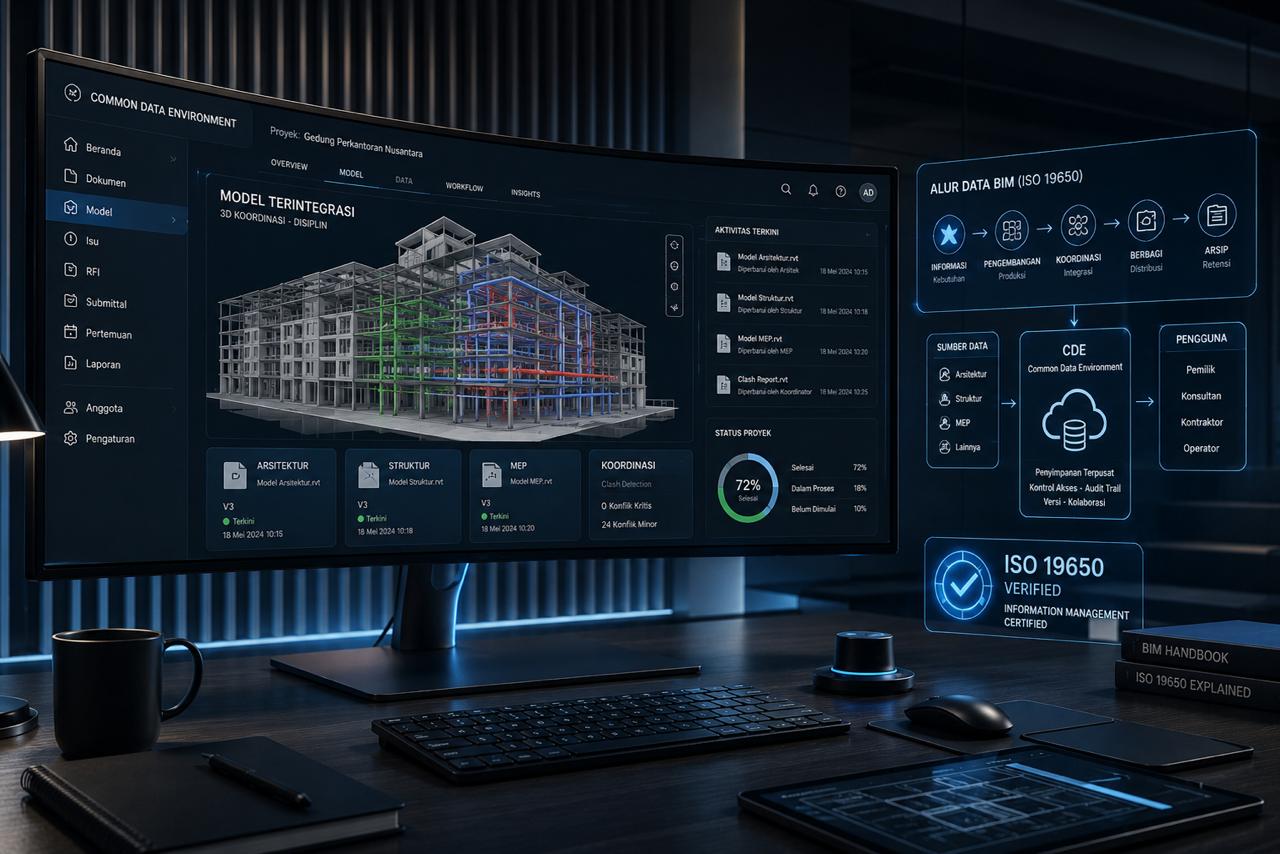
BIM stands for Building Information Modeling—a collaborative methodology built around a digital model that is transforming how construction projects are designed, built, and operated in Indonesia. More than 3D technology, BIM is a standardized workflow that unites architects, structural engineers, contractors, and facility managers in one central data environment. This article explains what BIM is in plain terms, its five core components, how it works, its benefits for owners and contractors, and how to start implementing it.
BIM Is a Methodology, Not Software
A common misconception is that BIM is software, when BIM is actually a methodology—a standardized workflow. Tools such as Autodesk Revit are simply the means to implement BIM. The methodology is governed by the international standard ISO 19650, which defines how information is managed, exchanged, and archived across a building asset's lifecycle. The consequence is important: an organization can use BIM software yet still not be ISO 19650 compliant if it does not run the right workflow. This is a common cause of failed BIM projects in Indonesia—they have the software, but they lack a BEP (BIM Execution Plan), a CDE (Common Data Environment), and structured information governance.
The 5 Core Components of BIM
A complete, compliant BIM setup rests on five core components:
1. BIM Execution Plan (BEP) — the document that defines the goals, scope, level of development, roles and responsibilities, and deliverables.
2. Common Data Environment (CDE) — a single platform to store, manage, and exchange project information, such as Autodesk Construction Cloud (ACC).
3. Multi-discipline BIM model — parametric 3D models per discipline (architecture, structure, MEP) that can be coordinated.
4. Level of Development (LOD) — a classification of information detail from LOD 100 (conceptual) to LOD 500 (as-built operational).
5. Information Delivery Plan — the schedule of when information passes from one party to another, usually synced to project milestones.
Without all five, a project may use 3D software but cannot yet be called BIM compliant.
How BIM Works in a Construction Project
A typical BIM workflow:
1. Brief phase — the owner and BIM team prepare the BEP that defines the project's information needs.
2. Concept and design phase — architects build the model at LOD 200, while structural and MEP engineers build parallel models, all synced in the CDE.
3. Coordination phase — clash detection runs regularly using Autodesk Navisworks to identify inter-discipline conflicts before construction.
4. Detailed design phase — the model is developed to LOD 300–400 with full technical information for tender documentation.
5. Construction phase — contractors use the model for planning, prefabrication, and 4D progress tracking.
6. Handover phase — the model is updated to LOD 500 as-built and handed to the facility manager with an asset registry and operational data.
This pattern keeps project information flowing smoothly from phase to phase, reducing rework and inconsistency.
Benefits of BIM for Owners and Contractors
For owners: lower total project cost through pre-construction clash detection and coordination, more accurate cost estimates via BIM 5D, and a complete digital information asset for facility management that reduces maintenance costs across the building's lifecycle.
For contractors: less on-site rework because clashes are caught in the model rather than on site, faster multi-discipline coordination, more accurate material take-off that reduces waste, and eligibility for Indonesian government tenders that require BIM.
For consultants: more structured project documentation, more efficient collaboration, and the ability to offer value-added services such as digital twin and facility management.
A less visible but significant benefit: a collaborative working culture that replaces traditional discipline silos with an integrated team.
BIM Implementation in Indonesia: Challenges and Solutions
BIM adoption in Indonesia faces three main challenges:
1. Availability of certified BIM modelers — the solution: partner with a certified BIM consultant such as BIMAGE Indonesia, plus invest in internal team training.
2. Software and training costs — the solution: start with a pilot project and scale gradually based on results.
3. Resistance from traditional engineering teams — the solution: leadership commitment, tiered training, and communicating the benefits with concrete data.
The main adoption drivers are Permen PUPR 22/2018, which mandates BIM for government buildings; the fully BIM-based IKN project; and large state-owned contractors (Hutama Karya, Waskita, PP) that have fully integrated BIM. The proven pattern: start with a pilot project, use an external consultant for the learning phase, then build an in-house BIM team gradually.
Where to Start
Teams ready to begin can follow these steps: (1) audit current state—assess your organization's BIM capability; (2) define a pilot project scope of moderate complexity; (3) engage a certified BIM consultant (Autodesk Gold Partner and ISO 19650); (4) prepare a BEP as the implementation blueprint; (5) procure software and training for the internal team; (6) run regular clash detection; (7) hand over BIM 7D to facility management. BIMAGE Indonesia provides an initial consultation to assess BIM readiness and map an implementation roadmap, along with BIM training and implementation mentoring for your team.
Get an Initial Consultation with BIMAGE Indonesia
BIMAGE Indonesia is an Autodesk Gold Partner and ACC Elite, certified to ISO 9001 and ISO 19650, with 400+ global projects across 8 countries. We help EPC contractors, property developers, and government agencies design and implement end-to-end BIM workflows to international standards, and we provide BIM training and implementation mentoring. Contact our team for an initial consultation about your organization's BIM readiness.
Related Articles
Explore related topics in the BIMAGE BIM guide:
- Complete guide to Building Information Modeling (BIM)
- What is BIM — a plain-English guide
- 10 real benefits of BIM for construction
- BIM in construction: design to operations
Frequently Asked Questions (FAQ)
What is BIM, exactly?
BIM is Building Information Modeling—a collaborative methodology built around a digital 3D model that combines geometry, data, and project information. BIM is not software; tools like Autodesk Revit are simply the means to implement the BIM methodology.
What is the difference between BIM and CAD?
CAD (Computer-Aided Design) only stores geometry (drawings). BIM stores a multidimensional database covering geometry plus technical, time, cost, and operational information. BIM supports real-time multi-discipline collaboration; CAD does not.
What software is used for BIM?
The most widely used platform in Indonesia is Autodesk Revit for architecture, structure, and MEP, with Autodesk Navisworks for clash detection and Autodesk Construction Cloud (ACC) as the Common Data Environment. SketchUp is commonly used for conceptual modeling in the early stages.
How much does BIM implementation cost?
It varies with project scale, complexity, and scope, including software licenses, consulting, and training. The investment generally returns value through reduced rework, more efficient coordination, and tender eligibility. BIMAGE prepares a specific estimate after assessing your project's needs.
Is BIM mandatory in Indonesia?
Yes for government projects above 2,000 m² under Permen PUPR No. 22 of 2018, and for the fully BIM-based IKN project. It is not yet mandatory for private projects, but it is a competitive advantage—especially for large tenders.