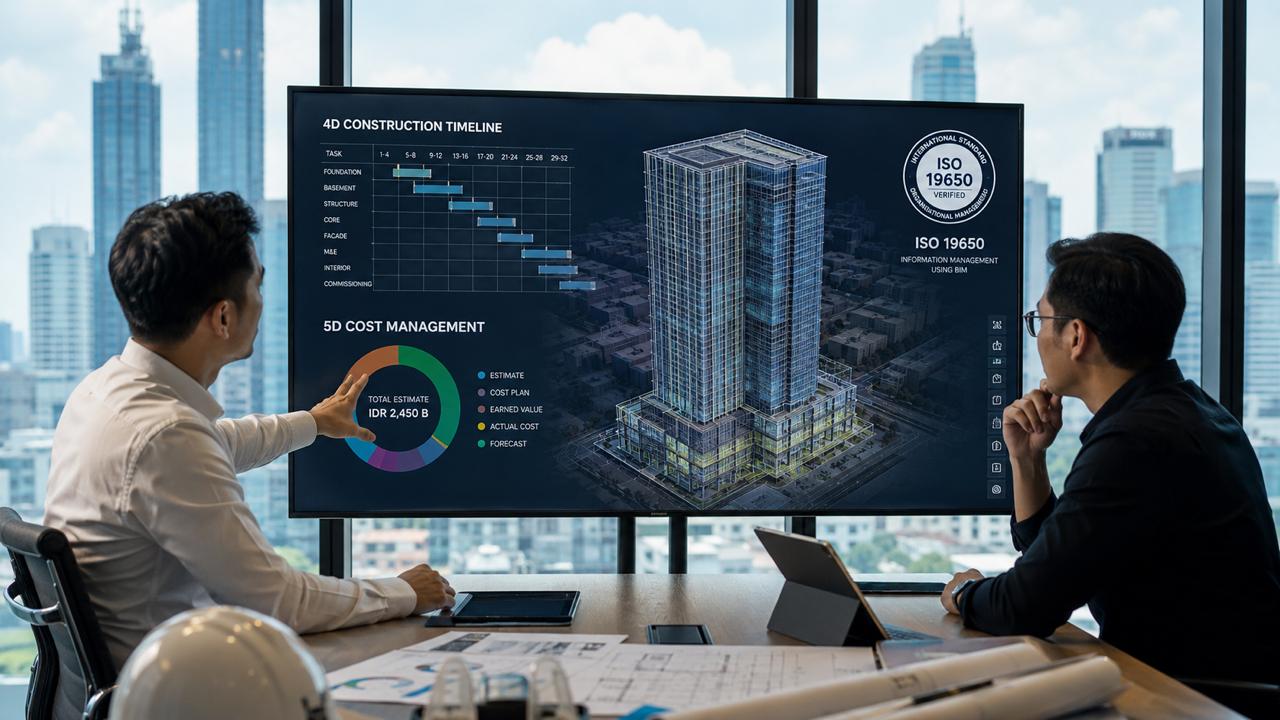
Building Information Modeling (BIM) has become a requirement in Indonesia's construction industry, not just a trend. Since Permen PUPR No. 22 of 2018 mandated BIM for government buildings above 2,000 m², and the IKN project was designed entirely on BIM, contractors, developers, and government agencies now face a single question: when—not whether—to integrate BIM into their project workflow. This guide explains BIM end to end for construction teams and companies: its components, the 2D–7D dimensions, the benefits, the compliance path, and practical steps to get started.
What Is Building Information Modeling (BIM)?
Building Information Modeling is a collaborative methodology built around a digital 3D model that combines geometry, data, and project information in one central environment. Unlike CAD, which only stores geometry (drawings), BIM holds a multidimensional information database that every project stakeholder can access, update, and analyze—from architects and structural engineers to contractors and facility managers. BIM is not a piece of software; it is a standardized workflow (ISO 19650) that can be run using tools such as Autodesk Revit as the primary platform, with SketchUp for conceptual modeling. In practice, BIM changes how projects are designed, built, and operated—shifting from a serial process to a parallel one on a single collaborative platform.
The 7 Dimensions of BIM (2D–7D)
BIM is classified into seven dimensions that describe the level of information and data complexity being managed.
- BIM 2D — traditional line-and-text drawings.
- BIM 3D — a three-dimensional geometric model that enables parametric visualization and clash detection across disciplines (architecture, structure, MEP).
- BIM 4D — adds the time dimension (scheduling); it integrates the construction schedule so teams can simulate the build phase by phase.
- BIM 5D — adds the cost dimension (cost estimation); it allows cost analysis to update as the design changes.
- BIM 6D — adds the sustainability dimension; energy, carbon, and environmental-impact simulation.
- BIM 7D — the operational dimension; it integrates facility data for post-construction building management, including maintenance schedules, asset registry, and IoT integration.
Most organizations in Indonesia start at BIM 3D, then progress to BIM 5D over their first few projects.
Benefits of BIM for Construction Teams in Indonesia
Based on BIMAGE's experience across 400+ global projects, full BIM implementation (minimum 4D + 5D) delivers far better control over cost and schedule than projects that stop at 3D. Concrete benefits include:
- Automatic clash detection that eliminates the majority of inter-discipline conflicts before construction begins, avoiding costly on-site rework.
- Faster multi-discipline coordination because every stakeholder works on the same model.
- More accurate cost estimates from the earliest stage via BIM 5D.
- Permen PUPR 22/2018 compliance — an eligibility prerequisite for government tenders above 2,000 m².
- Complete asset documentation for post-construction facility management, which lowers maintenance costs across the building's lifecycle.
For owners and developers, the most material benefit is reduced delay and claim risk during construction, plus a building-information asset that can be monetized through a digital twin during operations.
BIM Implementation in Indonesia's Construction Industry
BIM adoption in Indonesia is still relatively low; only a portion of national contractors have integrated it fully. The main drivers are Permen PUPR No. 22 of 2018, the BIM-based IKN project, and large state-owned contractors (Hutama Karya, Waskita, PP) that have built internal BIM divisions. The common pattern: contractors engage an external BIM consultant for their first project (the learning phase), then gradually build an in-house team. The main challenges are the availability of certified BIM modelers and resistance from traditional engineering teams. A proven solution is to partner with a certified BIM consultant such as BIMAGE Indonesia—an Autodesk Gold Partner and ISO 19650 certified—who also provides BIM training and implementation mentoring to build internal team capability. For structural workflows, BIMAGE uses Autodesk Revit, while infrastructure and site planning are handled with Autodesk InfraWorks and Civil 3D. The investment in BIM implementation varies with project scale, complexity, and scope, and it returns value through coordination efficiency, reduced rework, and tender eligibility.
Permen PUPR 22/2018 Compliance: What the Construction Industry Must Know
Permen PUPR No. 22 of 2018 on the Construction of State Buildings mandates BIM for all government buildings above 2,000 m² of floor area or more than two storeys. To take part in government tenders, you must: (1) integrate a BIM model in the tender documents (3D minimum; 4D + 5D for large projects); (2) have a BIM Execution Plan (BEP) aligned with ISO 19650; (3) have BIM-certified personnel or partner with a certified BIM consultant; and (4) use a Common Data Environment (CDE) for multi-party collaboration. Non-compliance means tender disqualification and failure to meet administrative requirements. The IKN and Smart City projects are designed entirely on BIM, so contractors without BIM capability are effectively excluded from strategic national projects. The PUPR Digital Construction Roadmap 2030 extends the BIM mandate to all government construction and makes it recommended practice for the private sector.
Lessons from 400+ Global BIMAGE Projects
On a high-rise office project in Jakarta, applying BIM 5D—integrating schedule and cost—significantly reduced cost overruns and accelerated the delivery timeline compared with similar projects. The keys were a BEP prepared before kickoff, regular clash detection during design to catch conflicts that usually surface only during construction, and a BIM 7D module so the building manager received a complete digital asset registry after handover. On a manufacturing-facility project in the Bekasi industrial area, combining BIM 4D + 5D helped eliminate the structural delays that had been the standard pattern on similar projects, saving idle-resource costs.
How to Start Implementing BIM
Practical steps for teams ready to begin:
1. Audit current state — assess your organization's BIM capability (team, software, workflow).
2. Define a pilot project scope — pick a project of moderate complexity as a learning case.
3. Engage a certified BIM consultant — an Autodesk Gold Partner and ISO 19650 certified to ensure an internationally standardized workflow.
4. Prepare a BIM Execution Plan (BEP) as your implementation blueprint—covering level of development (LOD), party responsibilities, deliverable file formats, and review schedule.
5. Procure software and training — Autodesk Revit for architecture, MEP, and structure; Autodesk Construction Cloud (ACC) as the Common Data Environment.
6. Run regular clash detection during design.
7. Hand over BIM 7D to facility management for lifecycle value.
BIMAGE Indonesia provides an initial consultation to assess readiness and map a BIM implementation roadmap, along with BIM training and implementation mentoring for your internal team.
Get an Initial Consultation with BIMAGE Indonesia
BIMAGE Indonesia is an Autodesk Gold Partner and ACC Elite, certified to ISO 9001 and ISO 19650, with 400+ global projects across 8 countries. We work with tier 1–2 EPC contractors, property developers, and government agencies to design, implement, and operate end-to-end BIM workflows. Beyond consulting and implementation, BIMAGE also provides BIM training and implementation mentoring to build your team's capability. Contact us for an initial consultation about your organization's BIM readiness and the roadmap that fits your project's timeline and budget.
Related Articles
Explore related topics in the BIMAGE BIM guide:
- BIM explained: definition, components, and benefits
- BIM dimensions 2D–7D explained
- 10 real benefits of BIM for construction
- How to choose a BIM consultant in Indonesia
Frequently Asked Questions (FAQ)
What is BIM?
BIM (Building Information Modeling) is a collaborative methodology built around a digital 3D model that combines geometry, data, and project information in one central environment. Unlike CAD, which only stores geometry, BIM holds a multidimensional information database accessible to every project stakeholder.
Is BIM mandatory for government projects in Indonesia?
Yes. Permen PUPR No. 22 of 2018 mandates BIM for all government buildings above 2,000 m² of floor area or more than two storeys. Contractors that do not meet the BIM requirement will not pass administrative tender screening.
How much does BIM implementation cost for a construction project?
The cost varies with project scale, complexity, and scope. The investment generally returns value through reduced rework, more efficient coordination, and government tender eligibility. BIMAGE prepares a specific estimate after assessing your project's needs.
What is the difference between BIM 3D, 4D, 5D, 6D, and 7D?
BIM 3D is parametric geometry. BIM 4D adds the time dimension (construction schedule). BIM 5D adds the cost dimension. BIM 6D adds the sustainability dimension (energy and carbon). BIM 7D is the operational dimension for post-construction facility management.
How long does BIM adoption take for a new organization?
For an end-to-end pilot project (planning to handover), it takes several months depending on complexity. Building in-house BIM capability from scratch takes longer, with tiered training and experience across several projects.
What international BIM standard is recognized in Indonesia?
ISO 19650 is the internationally recognized BIM standard and the reference for Permen PUPR 22/2018. Contractors and BIM consultants certified to ISO 19650 hold the highest credibility for government and international projects.