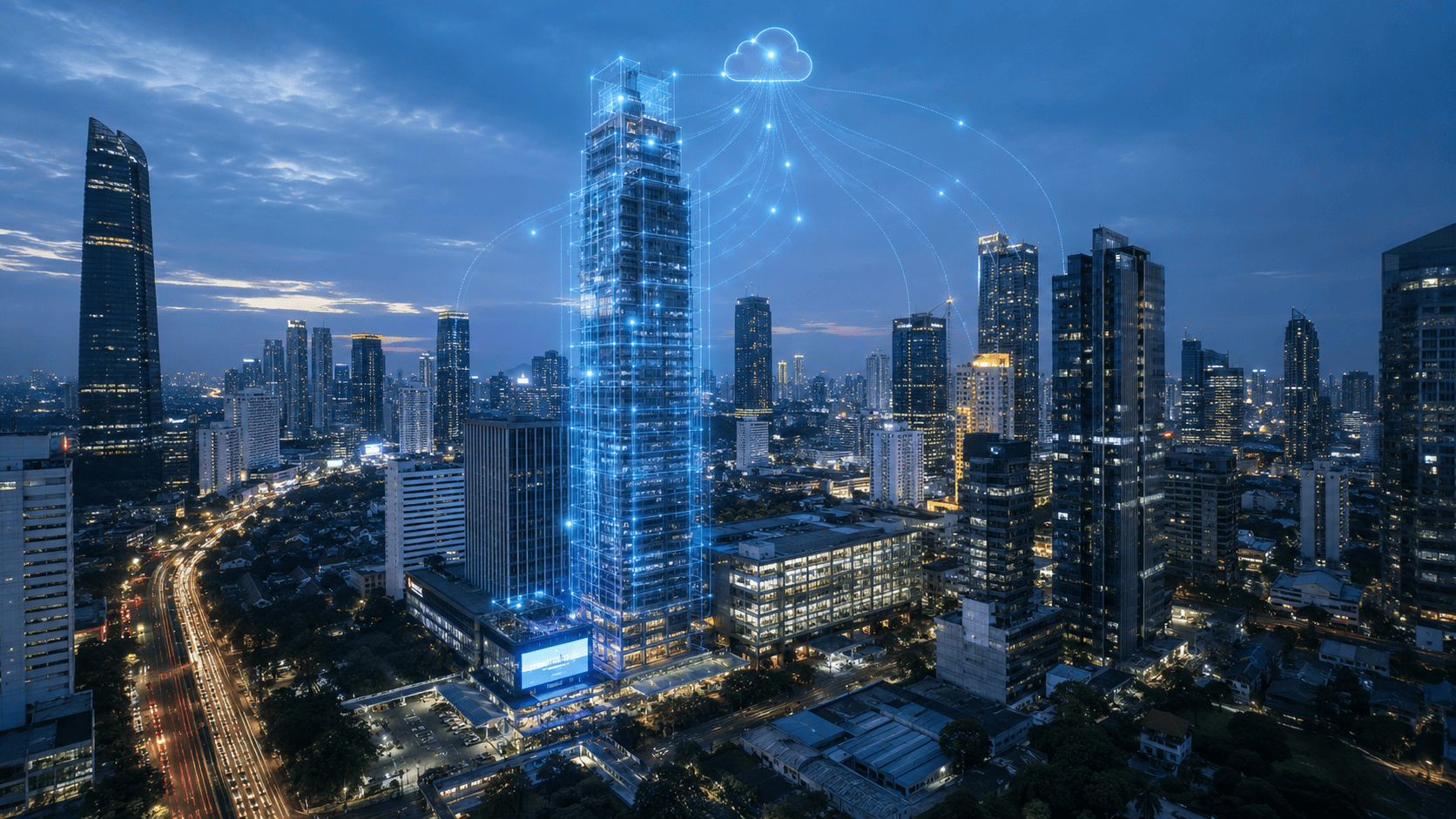
Smart buildings in Indonesia are growing fast, driven by the IKN project, green-building regulations, and competition among modern property developers. A smart building is not merely a building with automation—it is an integrated ecosystem combining IoT sensors, BMS automation, AI analytics, and BIM integration for efficient operations across the building's lifecycle. This article is a guide for construction professionals: the definition, core components, supporting technology, adoption in Indonesia, green-building regulations, and a roadmap to start.
What Is a Smart Building — 2026 Definition
A smart building uses a combination of IoT, a BMS (Building Management System), AI analytics, and BIM integration to optimize operations, occupant comfort, energy efficiency, and security. The definition has evolved from "a building with automation" to "an adaptive and proactive building"—able to predict occupant needs, optimize energy use automatically, and give the facility manager insight. A smart building meets at least three characteristics: connected (integrated systems that share data), automated (making routine operational decisions without manual intervention), and analytical (collecting and analyzing data for continuous improvement).
The 4 Core Components of a Smart Building
1. Sensors — IoT sensors to monitor the environment (temperature, humidity, air quality, occupancy) and equipment health (HVAC, elevators, electrical).
2. Network — the network infrastructure for data transmission, usually a mix of wired (for critical infrastructure) and wireless IoT (LoRaWAN, Zigbee, WiFi for high sensor density).
3. Analytics platform — software that aggregates sensor data and applies analytics and AI to produce insight, such as BIMAGE 360.
4. User experience layer — a dashboard for the facility manager and an app for occupants (meeting-room booking, personal AC control, issue reporting).
Supporting Technology (BIM, IoT, AI, Digital Twin)
BIM is the digital foundation of a smart building—the BIM 7D model stores the asset registry, sensor locations, and integration points. Without BIM, a smart building can still be implemented on a legacy building via retrofit, but with more limited capability. IoT is the layer of sensors and actuators that collect data and execute commands. AI and machine learning turn raw data into actionable insight—predictive maintenance, energy optimization, occupancy prediction. A digital twin is the highest integration layer, combining the BIM model, real-time data, and AI analytics—the latest evolution of the smart building, giving proactive and adaptive capability.
Smart Building in Indonesia — Adoption and Cases
Smart-building adoption in Indonesia keeps growing, especially among large commercial buildings in Jakarta that already use a modern BMS and IoT sensors. The leading players are tier 1 property developers such as Sinar Mas Land (BSD), Ciputra, and Summarecon. A typical implementation: a Class-A office building with a BMS integrating HVAC, lighting, security, and access control, plus a tenant app for personalization—generally yielding energy savings, higher occupant satisfaction, and better space utilization. The IKN project is Indonesia's smart-city showcase, built entirely on BIM + digital twin, and a reference architecture for other cities.
Regulations and Green Building in Indonesia
Regulations related to smart buildings in Indonesia: (1) Permen PUPR 22/2018—mandates BIM for government buildings, a prerequisite for modern smart buildings; (2) Greenship (GBCI)—a sustainability certification widely adopted by modern developers, which a smart building's energy management helps satisfy; (3) Green Building regulations—encouraging sustainable building practices; (4) international standards such as LEED, BREEAM, and WELL—pursued by tier 1 developers for premium positioning. A smart building combining BIM, IoT, and analytics is an enabler for the highest-tier green-building certifications, and the latest trend ties it to ESG reporting.
Roadmap: Where to Start
For new buildings: implement the smart building from the design phase via BIM 7D and a smart-building requirement in the BEP. For existing buildings: a phased retrofit—(1) audit current state (BMS, network, and opportunity areas); (2) quick wins such as basic energy management to prove early value; (3) expand sensors for lighting, HVAC zones, and occupancy; (4) an integration layer with an analytics and AI platform; (5) tenant experience through an app and personalized services. BIMAGE provides a smart-building readiness assessment and an implementation-roadmap consultation aligned with your organization's budget and timeline.
Get an Initial Consultation with BIMAGE Indonesia
BIMAGE Indonesia is an Autodesk Gold Partner and ACC Elite with experience implementing smart buildings and digital twins (BIMAGE 360) across commercial properties in Indonesia. We provide smart-building readiness assessment, end-to-end design and implementation, integration with BMS and ERP, and BIM training and implementation mentoring for the facility management team. Contact us for an initial consultation about your smart-building journey.
Related Articles
Explore related topics in the BIMAGE BIM guide:
- What is a smart building
- What is a digital twin
- Digital twin case studies in Indonesia
- Complete guide to Building Information Modeling (BIM)
Frequently Asked Questions (FAQ)
What is a smart building?
A smart building uses a combination of IoT sensors, a BMS, AI analytics, and BIM integration to optimize operations, occupant comfort, energy efficiency, and security. A modern smart building is adaptive and proactive, not merely reactive.
What are the core components of a smart building?
Four components: IoT sensors for monitoring, a network for data transmission, an analytics platform to produce insight, and a user-experience layer of dashboards and apps.
Is a smart building mandatory in Indonesia?
Not yet, but it is encouraged by Green Building regulations, Greenship (GBCI) certification, and international standards LEED, BREEAM, and WELL. Tier 1 developers treat it as a competitive differentiator.
Does a smart building require BIM?
Not mandatory, but strongly recommended. BIM 7D from construction handover makes a smart building easier and more economical to implement. For legacy buildings without BIM, a retrofit is still possible but more complex.
How do you start a smart building?
For new buildings, integrate it from design via BIM 7D. For existing buildings, start with quick wins such as energy management to prove value before expanding gradually.