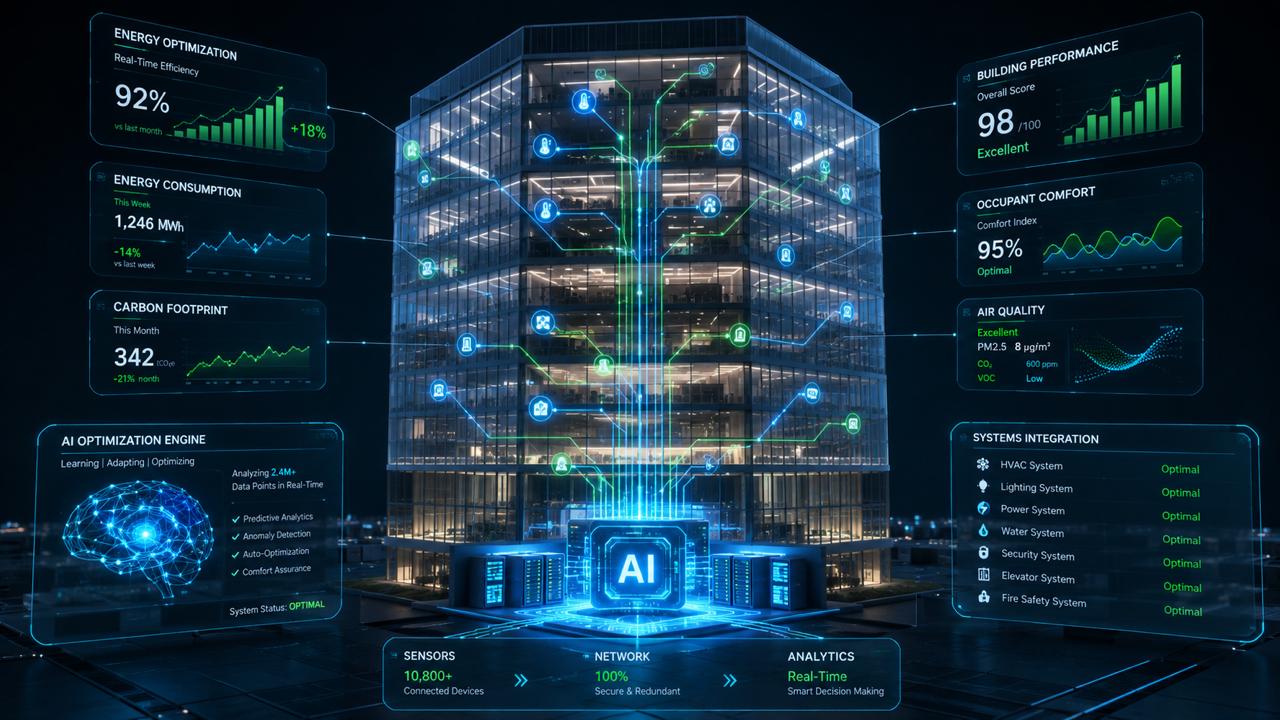
What is a smart building? If you are new to the concept and want to understand it for a project or building you manage, this article gives a practical explanation without heavy jargon: the definition of a smart building, the "brain and nerves" analogy, the core components, how it works end to end, how it differs from a smart home and a smart city, and the questions to ask before starting.
What Is a Smart Building — In Plain Terms
A smart building can "think" for itself to optimize day-to-day operations. Unlike a traditional, passive building (where people must manually switch on lights, set the AC, and lock doors), a smart building has sensors that sense conditions (whether people are present, whether the temperature rises or falls, whether energy is wasted) and an automation system that responds in real time (lights off when a room is empty, the AC adjusting temperature, an alert for abnormal energy use). The goal: a building that is comfortable for occupants, economical for owners, and easy for facility managers to run.
A Smart Building Analogy — The Building's Brain and Nerves
Picture a smart building like the human body. The IoT sensors spread throughout are the nervous system—sensing temperature, humidity, movement, and equipment condition. The computer network is the circulatory system—carrying information from sensors to the center. The AI analytics platform is the brain—processing information, making decisions, optimizing operations. The BMS that controls HVAC, lighting, and access is the organs—executing the brain's commands. If any component is weak, the building is not truly smart. A good smart building has all four components balanced and integrated.
The 4 Core Components of a Smart Building
1. Sensors — devices placed at various points to sense conditions (temperature per room, occupancy at entrances, energy meters at the electrical panel, vibration on HVAC equipment).
2. Network — the infrastructure connecting sensors to the central platform, which can mix wired (for reliability) and wireless (WiFi, LoRaWAN for flexibility).
3. Analytics platform — software that gathers data from all sensors and applies analytics to produce insight, such as BIMAGE 360.
4. User experience — a dashboard for the facility manager and an app for occupants (meeting-room booking, personal AC control, issue reporting).
How It Works End to End
A morning scenario in an office building: (1) an occupancy sensor in the lobby detects people entering; (2) the data is sent over the network to the analytics platform; (3) the platform predicts which floors will fill first and commands the BMS to pre-cool the HVAC on those floors; (4) when staff arrive, the temperature is already comfortable, while floors that usually fill later stay in energy-saving mode; (5) the platform keeps learning patterns and adjusts predictions automatically. The result: occupant comfort is maintained, energy is saved, and the facility manager does not have to schedule the HVAC manually.
Smart Building vs Smart Home vs Smart City
Smart home: the scale of a residence, focused on personal comfort through consumer smart-home devices. Smart building: the scale of a commercial or industrial building, focused on operational efficiency and tenant satisfaction. Smart city: the scale of a city, focused on public services and urban planning. The hierarchy: a smart home is a subset of a smart building, and a smart building is a subset of a smart city. In Indonesia, smart buildings are usually large office buildings or malls, while smart cities are still early-stage—pioneered by the IKN project and a few tier 1 cities. The implication: if you own a commercial building, your scope is the smart building; if you are a regional government, your scope is the smart city.
Questions Before Implementation
Before starting a smart building, ask: (1) What is the main goal—cost savings (energy, maintenance) or tenant satisfaction (premium positioning)? The goal sets the priorities. (2) What is the budget and the phased approach. (3) What is the timeline—smart-building maturity is reached gradually. (4) Is BIM 7D already available from construction handover—if yes, implementation is easier and more economical; if not (a legacy building), retrofitting is more complex. (5) The vendor strategy—a single-vendor approach is simpler but risks lock-in, while a multi-vendor approach with an agnostic integration platform is more flexible but requires integration expertise.
Get an Initial Consultation with BIMAGE Indonesia
BIMAGE Indonesia provides smart-building consulting for professionals just getting started. We provide smart-building readiness assessment, vendor evaluation and recommendation, end-to-end design and implementation via the BIMAGE 360 platform, and BIM training and implementation mentoring for the facility management team. Contact us for an initial consultation about a smart-building roadmap aligned with your organization's budget and goals.
Related Articles
Explore related topics in the BIMAGE BIM guide:
- Smart building Indonesia guide
- What is a digital twin
- Digital twin case studies in Indonesia
- Complete guide to Building Information Modeling (BIM)
Frequently Asked Questions (FAQ)
What is a smart building?
A smart building can "think" for itself to optimize operations using a combination of IoT sensors, a BMS, and AI analytics. It responds to real-time conditions for energy efficiency, occupant comfort, and easier facility management.
What is the difference between a smart building and a smart home?
A smart home is the scale of a residence focused on personal comfort. A smart building is the scale of a commercial building focused on operational efficiency and tenant satisfaction. A smart home is a subset of a smart building.
What are the core components of a smart building?
Four components: IoT sensors for monitoring, a network for data transmission, an analytics platform to produce insight, and a user-experience layer of dashboards and occupant apps.
Does a smart building have to use BIM?
Not mandatory, but strongly recommended. BIM 7D from construction handover makes a smart building easier and more economical. For legacy buildings without BIM, a retrofit is still possible but more complex.
How do you start a smart building?
For new buildings, integrate from design via BIM 7D. For existing buildings, start with quick wins such as energy management to prove value before expanding gradually.