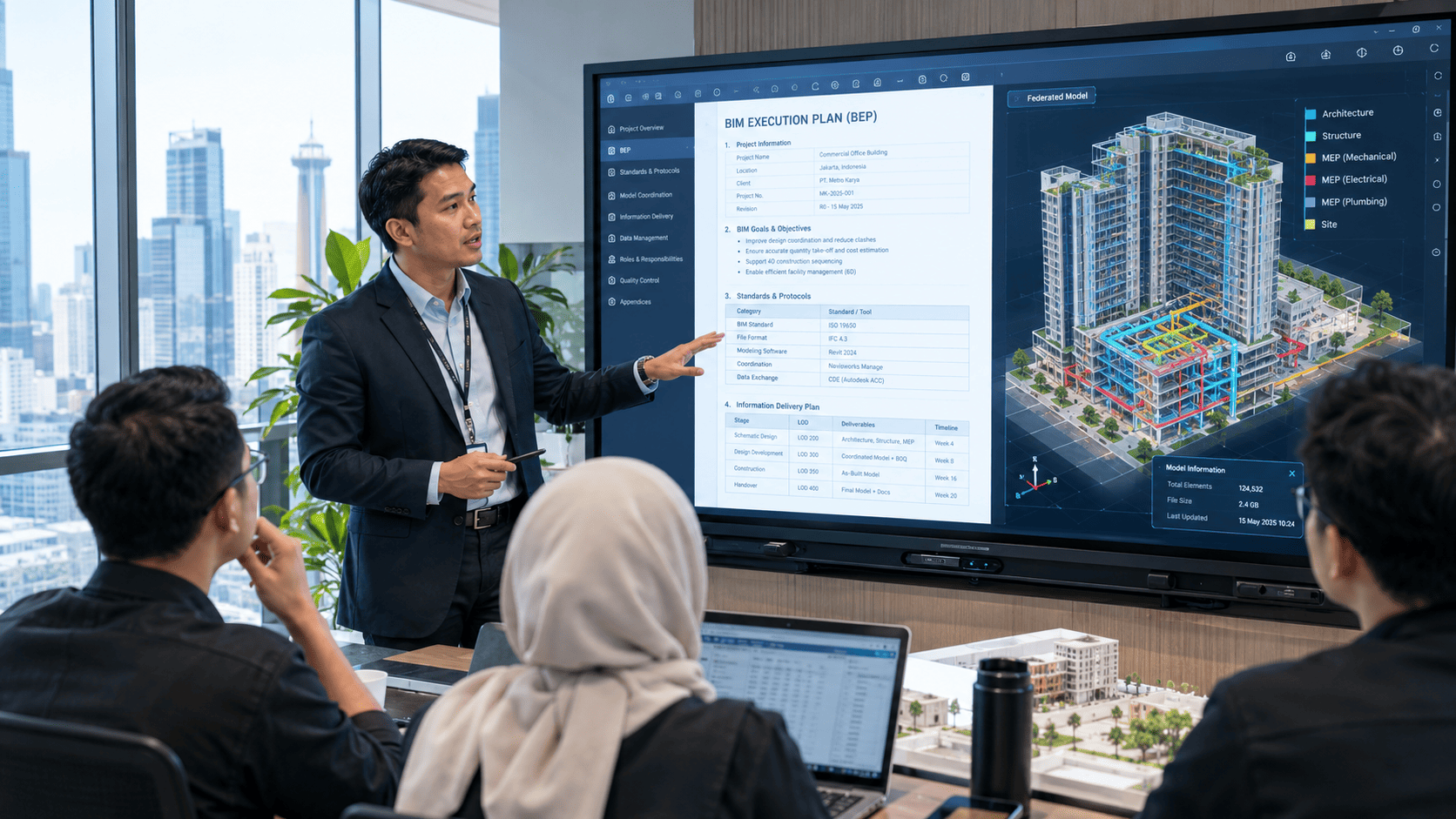
A BIM manager is responsible for information standards and quality across a project or an organisation. The focus is not modelling but making sure every party produces information in the same structure, in a form that supports decisions.
How do BIM manager, coordinator and modeler differ?
The three are often treated as grades of one job, but their focus and output differ. The table separates them.
| Role | Primary focus | Typical output |
| BIM modeler | Building discipline models | Models and working drawings |
| BIM coordinator | Federating models across disciplines | Coordination reports and clash findings |
| BIM manager | Standards, quality and information flow | BEP, naming conventions, data quality policy |
In small organisations one person often covers all three, and that works while there is one project. Problems arrive as project count grows and standards start diverging between teams — at which point nobody holds authority to reconcile them, because everyone is occupied with their own project.
How are BIM competency levels defined in Indonesia?
Indonesia has a formal framework for this. SKKNI No. 3 of 2023 establishes the Indonesian National Work Competency Standard for Building Information Modeling, under the professional, scientific and technical activities category within architecture and engineering.
The framework divides BIM work into four job roles at different qualification levels. This matters both for organisations structuring a team and for individuals planning a career path.
| Job role | Qualification level |
| BIM Manager | Level 7 or 8 |
| BIM Coordinator | Level 5 or 6 |
| BIM Modeler | Level 3 or 4 |
| BIM Draughtsperson | Level 2 or 3 |
Competency certification against this standard runs through certification schemes referencing the SKKNI. For companies, holding certified personnel increasingly forms part of qualification assessment in procurement — following the same pattern as ISO 19650 requirements.
For individuals, the framework provides a map that did not previously exist. Moving from BIM Coordinator to BIM Manager is not merely a job title promotion but a two-level qualification jump demanding different competency units.
What does a BIM manager actually do?
Five duties form the core of the role, and all of them are about setting rules rather than producing work.
- Writing and maintaining the BIM Execution Plan, including making sure it answers the owner’s information requirements.
- Setting naming conventions and data structures that apply across projects rather than being rewritten each time.
- Making sure the shared data environment runs to the agreed status and approval flow.
- Checking model quality before issue, against written criteria that can be re-checked by someone else.
- Training new team members so standards survive changes in team composition.
The fifth is the most neglected and the most decisive for whether standards last. A standard understood only by its author erodes within two or three projects, because every new member arrives carrying habits from somewhere else.
Which skills does the role require?
Technical skill is the entry condition, not the differentiator. What decides the outcome is the ability to enforce a standard without stopping other people’s work — and most of that is not a technical skill.
- Understanding modelling workflows across several disciplines, not one, so standards decisions do not disadvantage any party.
- Understanding information management standards such as ISO 19650 and how they translate into project documents.
- Writing documents others can follow without additional explanation.
- Negotiating when standards collide with deadlines, because that collision is certain.
- Patience in training, because a standard survives only when its reasoning is understood rather than merely followed.
The fourth is the usual failure point. A BIM manager who always yields to the deadline loses the standard within one project; one who never yields loses team support in roughly the same time. That balance is what separates the role from a purely technical one.
What does the career path look like?
The usual path runs from modelling to coordination to standards management — matching the levels set out in the SKKNI. The move from coordinator to manager is the hardest, because responsibility shifts from solving technical problems to preventing them recurring.
That shift is not automatic. An excellent coordinator is not necessarily an effective manager, because the skill that made them successful — resolving problems quickly, one at a time — differs from what is needed to design a system that produces fewer problems.
Some organisations accelerate the transition through mentoring on live projects rather than classroom training alone. The reasoning is simple: enforcing a standard can only be practised where a deadline is pressing and somebody objects.
Frequently Asked Questions
What does a BIM manager do?
They are responsible for information standards and quality on a project or across an organisation: writing the BIM Execution Plan, setting naming conventions and data structures, keeping the shared data environment running, checking model quality before issue, and training new team members. The focus is setting rules, not modelling.
BIM manager level in SKKNI?
SKKNI No. 3 of 2023 for Building Information Modeling places BIM Manager at qualification level 7 or 8. Below it sit BIM Coordinator at level 5 or 6, BIM Modeler at level 3 or 4, and BIM Draughtsperson at level 2 or 3.
BIM manager vs coordinator?
A BIM coordinator federates models across disciplines and produces coordination reports and clash findings. A BIM manager sets the standards, quality criteria and information flow, with the BEP and data policy as output. A coordinator resolves problems; a manager designs the system so fewer arise.
Is a civil engineering background required?
Not necessarily, though understanding construction process helps considerably, because most decisions concern work sequence and the division of responsibility between parties. What matters more is understanding workflows across several disciplines rather than depth in one.
Sources
- SKKNI No. 3 Tahun 2023 bidang Building Information Modeling — JDIH Kementerian Ketenagakerjaan — https://jdih.kemnaker.go.id/asset/data_puu/SKKNI_2023-003.pdf
- ISO — Building information modelling (BIM), seri ISO 19650 — https://www.iso.org/sectors/building-construction/building-information-modelling
- ISO 19650-2:2018 — Delivery phase of the assets — https://www.iso.org/standard/68080.html
Get an Initial Consultation with BIMAGE Indonesia
BIMAGE Indonesia provides BIM training and implementation mentoring, including writing information standards and transferring ownership of them to internal teams in stages. If your organisation is building a BIM manager role from within, mentoring on a live project is considerably more effective than classroom training — contact us for an initial consultation.