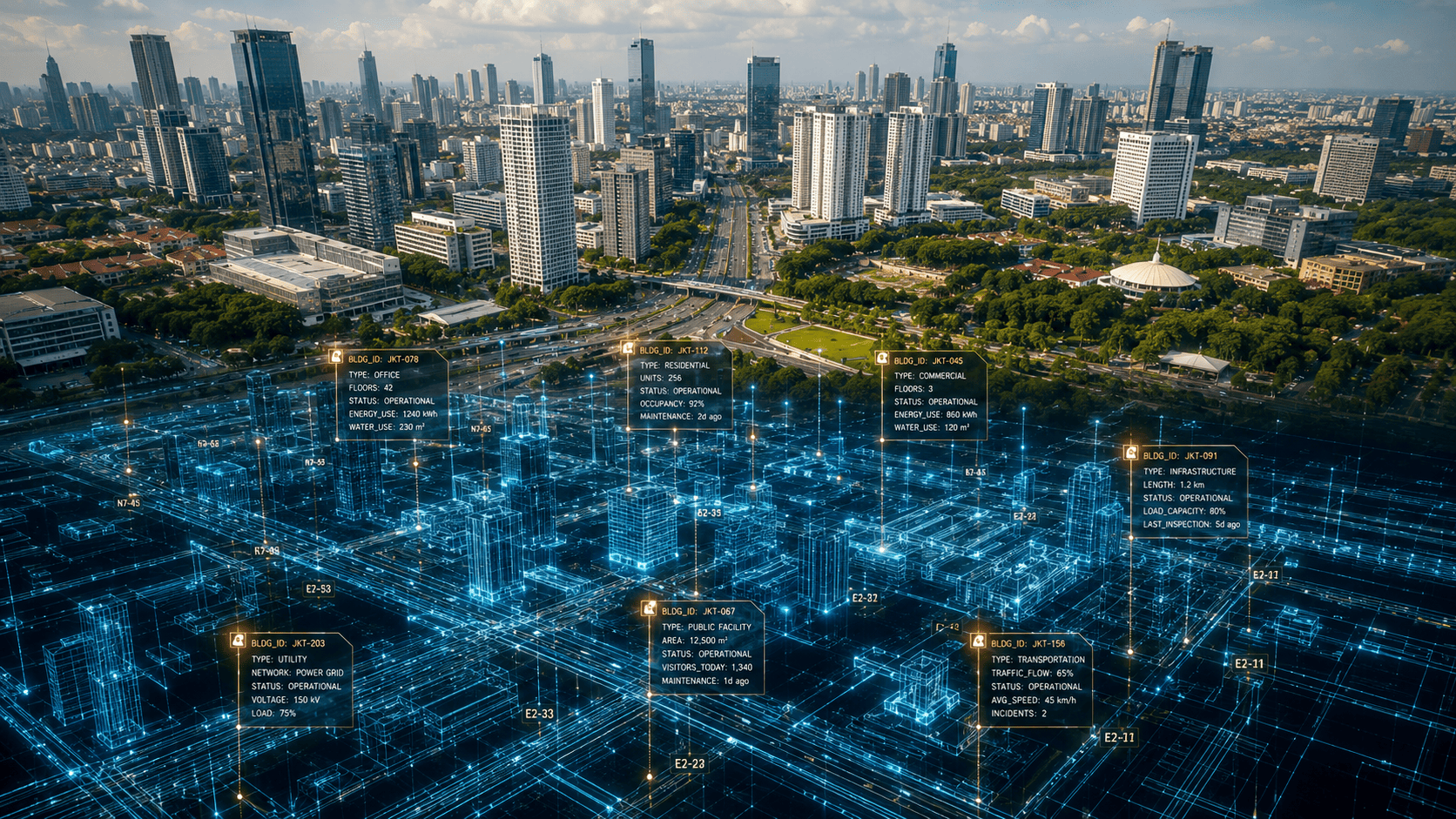
A smart city manages urban services on decisions grounded in data collected continuously from infrastructure, buildings and public services. The point is not how much technology is installed but whether the city’s condition can be read in time to act on it.
What are the layers of a smart city?
Four layers form the system, and each depends on the one beneath it. Skipping a layer is the most common cause of failure.
| Layer | Content | What decides success |
| Physical assets | Buildings, roads, utilities | Completeness and accuracy of their asset data |
| Data collection | Sensors and operational systems | Consistent asset identity across systems |
| Integration | Unifying data across sources | Agreed naming and format standards |
| Use | Analysis and decision-making | Clarity on who uses which data for which decision |
Most initiatives stall at the second layer. Sensors go in, data accumulates in volume, but it cannot be unified because asset identity differs between systems. The symptom is distinctive: a dashboard showing figures from one system while the others are still opened separately.
What is a realistic implementation sequence?
The sequence below succeeds far more often than its reverse, and each step delivers value on its own even if the programme stops midway.
- Tidy the asset data you already hold before adding new data sources.
- Set naming and attribute standards that apply across agencies or across buildings.
- Pick one service as a pilot, with success measures agreed before it starts.
- Expand to the next service only once the pilot is proven in use — not once it is proven to function.
The sequence is often reversed. Pilots start first because they are easier to fund and easier to present, and data gets tidied afterwards. The result is hard to scale: every expansion repeats reconciliation work that should have been done once.
The distinction between "proven to function" and "proven in use" in step four is decisive. Many pilots work perfectly in technical terms and are never opened again after the launch event.
What role does building data play?
A city is a collection of buildings. If every building hands over asset data in a different structure, unification at city level becomes a large job repeated each time another building joins.
- An accurate as-built model becomes the source of asset identity every other system references.
- Uniform equipment attributes allow performance comparison between buildings on a shared basis.
- Recorded maintenance history allows condition-based budget planning rather than age-based assumptions.
The second point is worth most to portfolio operators. Without uniform attributes, a simple question such as which building consumes most energy per square metre cannot be answered without manual reconciliation every time it is asked.
Why do smart city initiatives stall at pilot stage?
Four causes recur, and all four are organisational rather than technical.
- Success measures were never agreed, so the outcome cannot be judged and continuation is hard to justify.
- Pilot data cannot be reused because its structure was built specifically for the pilot.
- Nobody was appointed to maintain the data after the pilot ended and its budget closed.
- Focus went to the interface rather than the data quality beneath it. An interface is easy to assess in a meeting; data quality is not.
The fourth is hardest to resist because it runs against how programmes are evaluated. Tidying data produces nothing presentable, while an attractive dashboard fits on one screen. The order of actual value is the reverse.
Where should you start?
For a building or estate operator, the safest starting point is making one building’s asset data clean and readable by the maintenance system. That work carries its own value — the maintenance team feels it immediately — and simultaneously forms the foundation if scope widens later.
The advantage is low risk. If the larger programme never proceeds, the work already done remains useful. Compare that with starting from sensor installation, whose value disappears entirely if integration never happens.
Frequently Asked Questions
Does smart city need big investment?
It does not have to start big. The decisive stage is tidying the asset data you already hold, and that demands discipline more than technology spending. Large investment in sensors and interfaces before asset data is clean is the spending pattern that most often returns nothing.
Smart city vs smart building?
A smart building concerns one building; a smart city unifies many assets and infrastructure across operators. The data principles are the same. What is far harder at city scale is agreeing one naming standard among many parties who have each worked independently.
Who leads these initiatives?
It depends on scope. For a single estate it is usually the asset operator, who holds full authority over data standards. At city scale it involves many agencies, and there agreeing data standards becomes more decisive than choosing technology.
How does BIM relate to smart city?
BIM produces consistent asset data structure from the design and construction stages, so handed-over data is usable in operations immediately. Without it, every building joining the city system requires its own reconciliation work.
Sources
- ISO 19650-3:2020 — Operational phase of the assets — https://www.iso.org/standard/75109.html
- ISO 19650-4:2022 — Information exchange — https://www.iso.org/standard/78246.html
- ISO — Building information modelling (BIM), seri ISO 19650 — https://www.iso.org/sectors/building-construction/building-information-modelling
Get an Initial Consultation with BIMAGE Indonesia
BIMAGE Indonesia supports asset data standards, as-built modelling and operational data integration through the BIMAGE 360 platform, including for estate operators running many buildings. If you manage more than one building and their data cannot yet be compared, standardisation is the first step — bring your asset register to an initial consultation.