The benefits of BIM are often mentioned but rarely explained concretely. This article summarizes 10 benefits of BIM based on BIMAGE's experience across 400+ global projects—framed so construction teams and companies can build a strong business case for BIM investment. The most important question it answers: what concrete value will your project gain from BIM?
10 Real Benefits of BIM
1. Better cost-overrun control on projects with full BIM (minimum 4D + 5D) versus those that stop at 3D.
2. Faster multi-discipline coordination because every stakeholder works on the same model.
3. More accurate cost estimates via BIM 5D than with traditional methods.
4. Elimination of most inter-discipline clashes before construction—conflicts caught in the model, not on site.
5. Less rework during construction because design issues are identified earlier.
6. Lower material waste through more precise automated take-off.
7. Faster delivery on medium-to-large projects thanks to parallel multi-discipline workflows.
8. Permen PUPR 22/2018 compliance — an eligibility prerequisite for government tenders.
9. Lower post-construction maintenance costs via the BIM 7D digital asset for facility management.
10. Better site safety because 4D simulation surfaces health-and-safety risks invisible on 2D drawings.
Lessons from 400+ Global Projects
A consistent pattern across BIMAGE's portfolio: the more complex a project (multi-stakeholder, multi-discipline), the greater the value BIM delivers. On a high-rise office project in Jakarta, applying BIM 5D—integrating schedule and cost—significantly reduced cost overruns and accelerated the timeline versus similar projects. On a manufacturing facility in the Bekasi industrial area, combining BIM 4D + 5D helped eliminate the structural delays that had been the standard pattern. For small, single-discipline projects, BIM's value tends to be less material because the overhead is not yet proportional to the scale.
Benefits by Stakeholder
- Owners: a complete digital information asset, predictable cost and timeline, and cheaper lifecycle facility management.
- Contractors: less rework, government tender eligibility, and the ability to handle larger projects with the same team.
- Architecture/engineering consultants: more efficient collaboration, more structured documentation, and the chance to offer value-added services such as digital twin.
- Subcontractors: clear coordination, accurate material take-off, and a synchronized schedule.
- Facility managers: a digital asset registry after handover, predictive maintenance, and IoT integration for smart buildings.
An often-underestimated cross-stakeholder benefit: a collaborative working culture that replaces traditional silos with an integrated team.
Long-Term Benefits for Facility Management
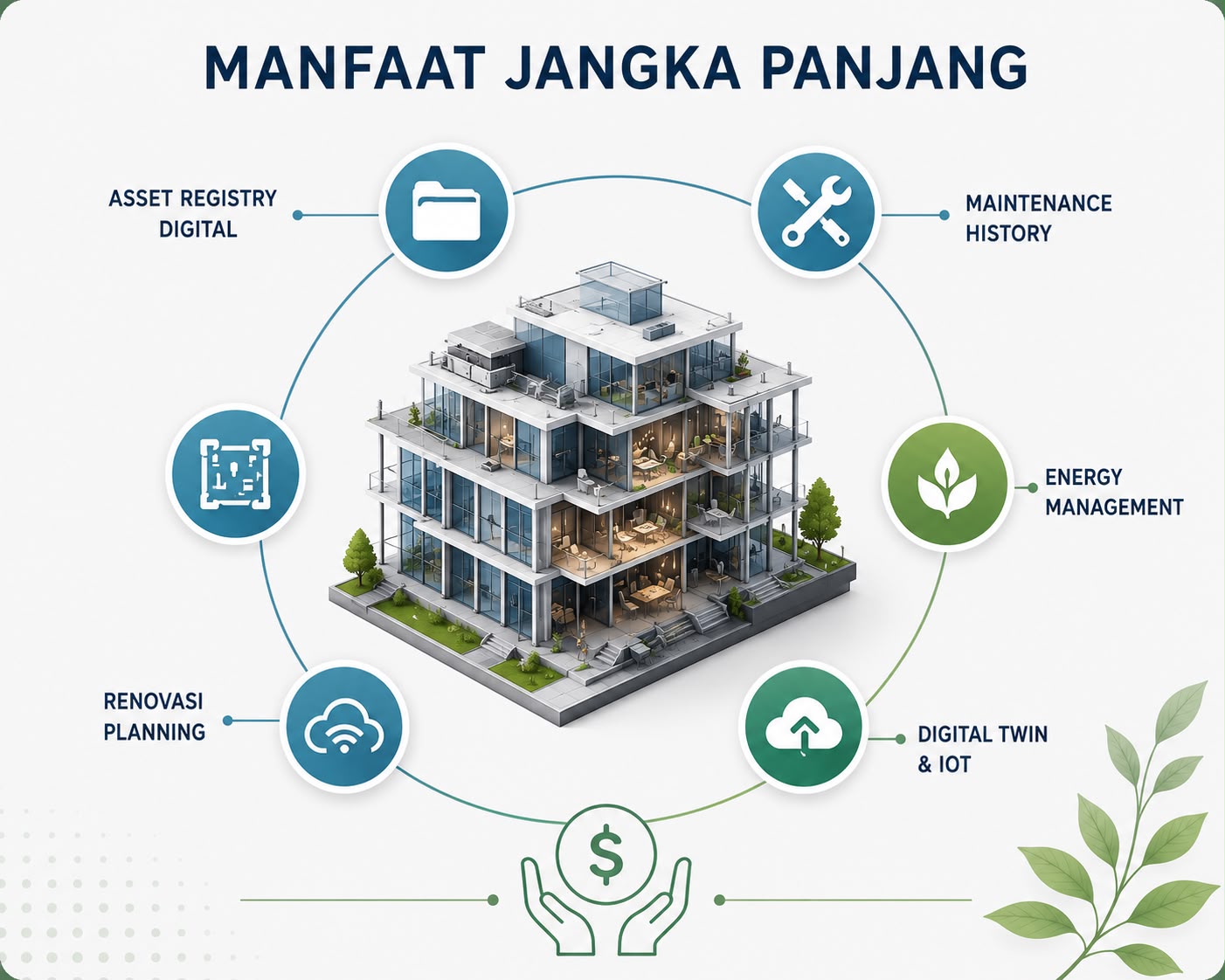
BIM's benefits do not end at handover. The BIM 7D digital asset supports facility management across the building's lifecycle through: (1) a digital asset registry—precise location of every component (HVAC, electrical, plumbing) for maintenance scheduling; (2) documented maintenance history in the model; (3) energy management—integration with a Building Management System to monitor energy use; (4) renovation planning—the existing model becomes the starting point, so there is no need to re-survey; (5) a digital twin—integration with IoT sensors to monitor building condition in real time.
How to Measure BIM ROI on Your Project
A measurement framework you can apply: (1) set a baseline—historical cost overruns, average delays, and rework on similar non-BIM projects; (2) identify BIM costs—software licenses, the BIM consultant, team training, and CDE setup; (3) track BIM benefits—clashes detected in the model, actual cost overruns versus baseline, and actual timeline versus baseline; (4) calculate ROI—(total benefit − total cost) / total cost. Organizations that apply BIM consistently across many projects generally gain more value over time as the learning curve and asset reuse (templates, family libraries) compound. BIMAGE provides an ROI calculator template for a quick assessment based on your organization's baseline.
Get an Initial Consultation with BIMAGE Indonesia
BIMAGE Indonesia has 400+ global projects to draw on for assessing BIM's benefits across different scales and complexities. Our team can help you build a board-ready business case for BIM investment, complete with projections based on your organization's baseline. BIMAGE also provides BIM training and implementation mentoring. Contact us for an initial consultation about your specific project.
Related Articles
Explore related topics in the BIMAGE BIM guide:
- Complete guide to Building Information Modeling (BIM)
- BIM dimensions 2D–7D explained
- BIM in construction: design to operations
- How to choose a BIM consultant in Indonesia
Frequently Asked Questions (FAQ)
What are the main benefits of BIM for construction projects?
Three main benefits: better cost-overrun control through pre-construction clash detection and coordination, faster multi-discipline coordination, and more accurate cost estimates via BIM 5D.
How do you measure the ROI of BIM investment?
Set a baseline (historical overruns, delays, rework), identify BIM costs, then compare the actual results of the BIM project against that baseline. The value tends to grow as BIM is applied consistently across many projects.
Does BIM reduce construction costs?
Yes. BIM curbs cost overruns through clash detection, reduces material waste, and lowers rework. The magnitude depends on project complexity and how complete the BIM implementation is.
What are the benefits of BIM for facility management?
The BIM 7D digital asset supports an asset registry, maintenance scheduling, energy management, renovation planning, and IoT integration for smart buildings across the building's lifecycle.
Is BIM suitable for every project scale?
BIM delivers the most material benefit on large, complex projects. For small projects the overhead may not yet be worth it. For government projects above 2,000 m², BIM is mandatory under Permen PUPR 22/2018.