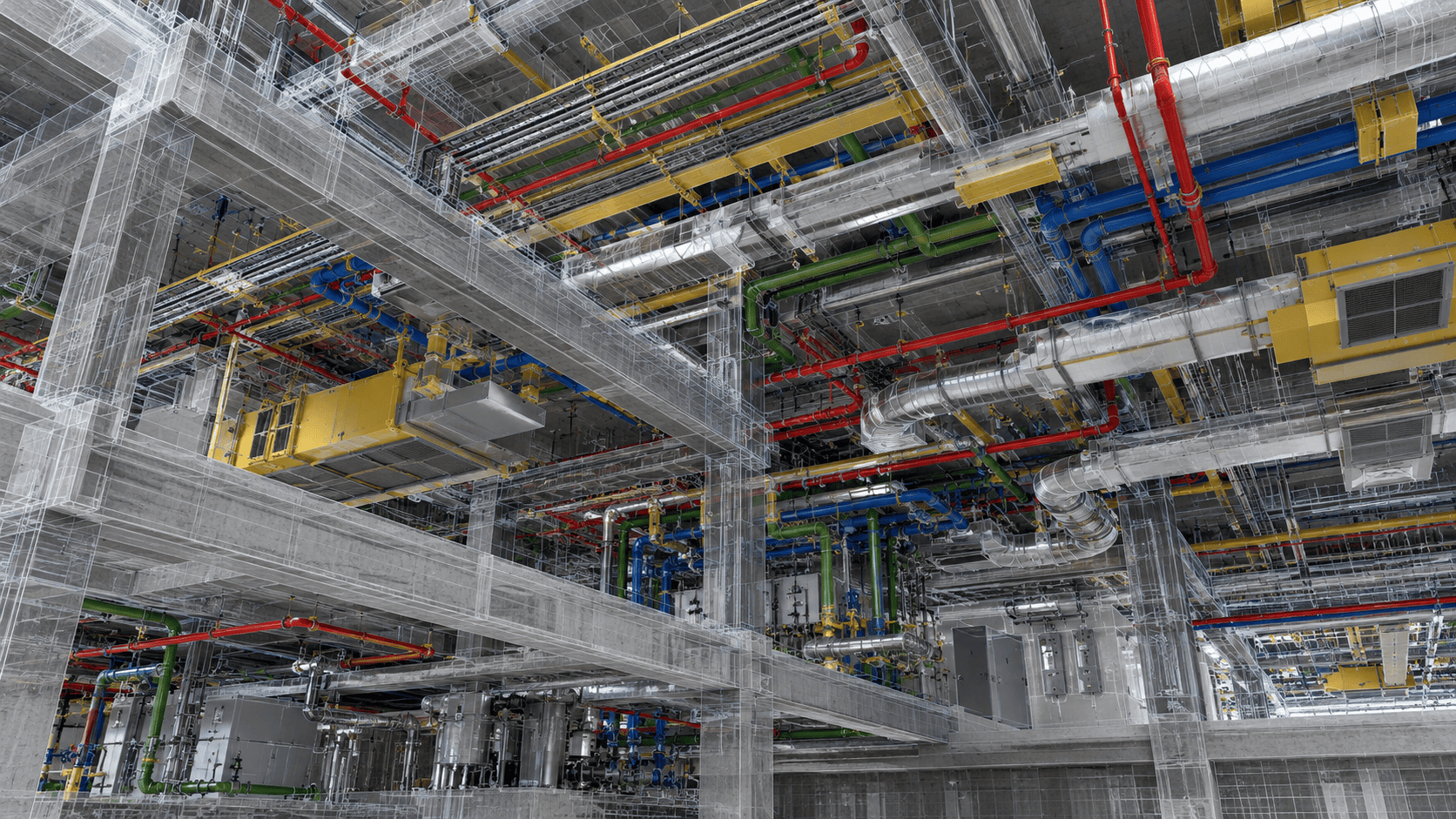
What Is MEP construction?
BIM-based MEP coordination aligns mechanical, electrical, and plumbing systems with architecture, structure, and construction requirements through models and data that can be reviewed together. The objective is not merely to find clashes, but to ensure systems have space, installation access, maintenance access, and documented decisions before site work begins.
MEP is often the densest part of a building project because many systems share ceiling voids, shafts, risers, plant rooms, and service routes. Without a clear workflow, teams only react after problems appear on site. Good coordination turns technical discussion into a traceable sequence of decisions.
Why This Matters for Projects
A clash report alone is not enough. Some findings are real conflicts, some are planned clearances, and others require design or construction decisions. If models, tolerances, issue owners, due dates, and approval status are not agreed, coordination becomes a problem list without verifiable closure.
For the Indonesian market, implementation should account for different levels of digital capability across stakeholders, layered approval processes, tender requirements, and projects that still receive a mix of models, DWG, PDF, spreadsheets, and vendor data. The implementation objective therefore needs to become an executable workflow rather than stopping at a software demonstration.
Key Decisions and Components
Controlled models and scope. Each discipline should agree on the areas, levels, zones, detail, and model-responsibility boundaries under review. Unready or mismatched versions create unproductive issues and consume meeting time.
Space-priority rules. Space in ceiling voids, shafts, and plant rooms cannot be resolved merely by moving elements. Projects need priority rules that consider structure, gravity, slope, duct size, valve access, clearance, fire requirements, and constructability.
Issue management. Each issue needs a location, description, severity, owner, due date, decision, and status. Screenshots provide context, but decision records and model versions are the evidence that makes issue closure traceable.
Site validation. Digital coordination must be tested against installation sequence, construction tolerances, material lead times, worker access, lifting equipment, and existing conditions. A clean model does not automatically mean the solution can be built safely and efficiently.
Implementation Workflow
The following sequence can serve as a baseline. Final details should follow contracts, phases, risk profiles, and project roles:
- Set the models entering review, priority zones, level of detail, and cut-off date for each cycle.
- Set clearance rules, system priorities, and the issue criteria that must be taken to meetings.
- Run model federation and quality checks before issues are discussed across disciplines.
- Assign each issue to an owner who can make the decision, then set a due date and closure evidence.
- Validate priority solutions with the construction team before an approved model is used as the basis for work.
Each stage should produce reviewable evidence such as standards, model versions, decision logs, issue registers, approved outputs, or acceptance records. Teams can then assess progress through information and decision quality rather than activity alone.
Project Use Cases
- Coordination of ceiling corridors, risers, shafts, and plant rooms in multi-storey buildings.
- Review of MEP routing with structure, architecture, maintenance access, and installation sequence.
- Preparation of technical decisions before shop drawings and site work are issued.
The first use case should be small enough to control but real enough to test data, roles, approvals, and outputs. An overly simple pilot often fails to reveal genuine implementation barriers.
Readiness Checklist
- Every issue has an owner, due date, decision, and closure evidence in the related model or deliverable.
- Clearance rules and system priorities are known by every discipline participating in coordination.
- Reviewed models use clear versions, zones, and scopes.
- Critical solutions have been confirmed by people who understand construction conditions and sequence.
If most criteria are not yet met, do not expand the scope immediately. Prioritize standards, ownership, and the pilot until teams can produce consistent outputs.
The Role of BIMAGE Indonesia
BIMAGE Indonesia can support MEP coordination workflows from scope setup, rule sets, model review, and issue management to constructability validation. As an Autodesk Gold Partner + ACC Elite, BIMAGE helps teams build a repeatable project process rather than simply resolving one clash report.
The engagement can start with discovery and assessment so recommendations reflect project conditions, internal capability, and business objectives. Final scope, schedule, and deliverables are defined after requirements are verified.
Mistakes to Avoid
- Treating every clash as something to eliminate without considering clearance rules and design intent.
- Discussing issues without an owner who has the authority to decide.
- Closing issues from a screenshot without verifying the model version or affected output.
These issues are rarely software problems alone. Their root causes usually involve scope, data, responsibilities, reviews, or uncontrolled changes. Corrective action should address both the process and tool configuration.
Next Step
If your team is evaluating MEP construction, start by mapping the current condition, target deliverables, stakeholders, and implementation risks. BIMAGE Indonesia can support an initial consultation with us to assess readiness, select a pilot, and develop a roadmap aligned with project priorities.
Frequently Asked Questions (FAQ)
Is MEP coordination only clash detection?
No. Clash detection is one input. Coordination also covers space, clearance, access, system priorities, design decisions, and constructability validation.
Who should close a coordination issue?
The issue owner should come from the discipline or party authorized to decide the change. A BIM coordinator manages the process and evidence, but is not always the technical decision maker.
When should MEP coordination start?
Start when models and information are sufficient to assess space, routing, and multidisciplinary decisions. Do not wait until site work has already been installed.
What coordination outputs should be retained?
Retain model versions, issue registers, meeting decisions, approval status, and affected deliverables. This is important for traceability when changes arise later.
Related Articles
- MEP in Construction: How BIM Coordinates Building Systems
- BIM-Based Shop Drawing Services: Scope, Workflow, and Deliverables