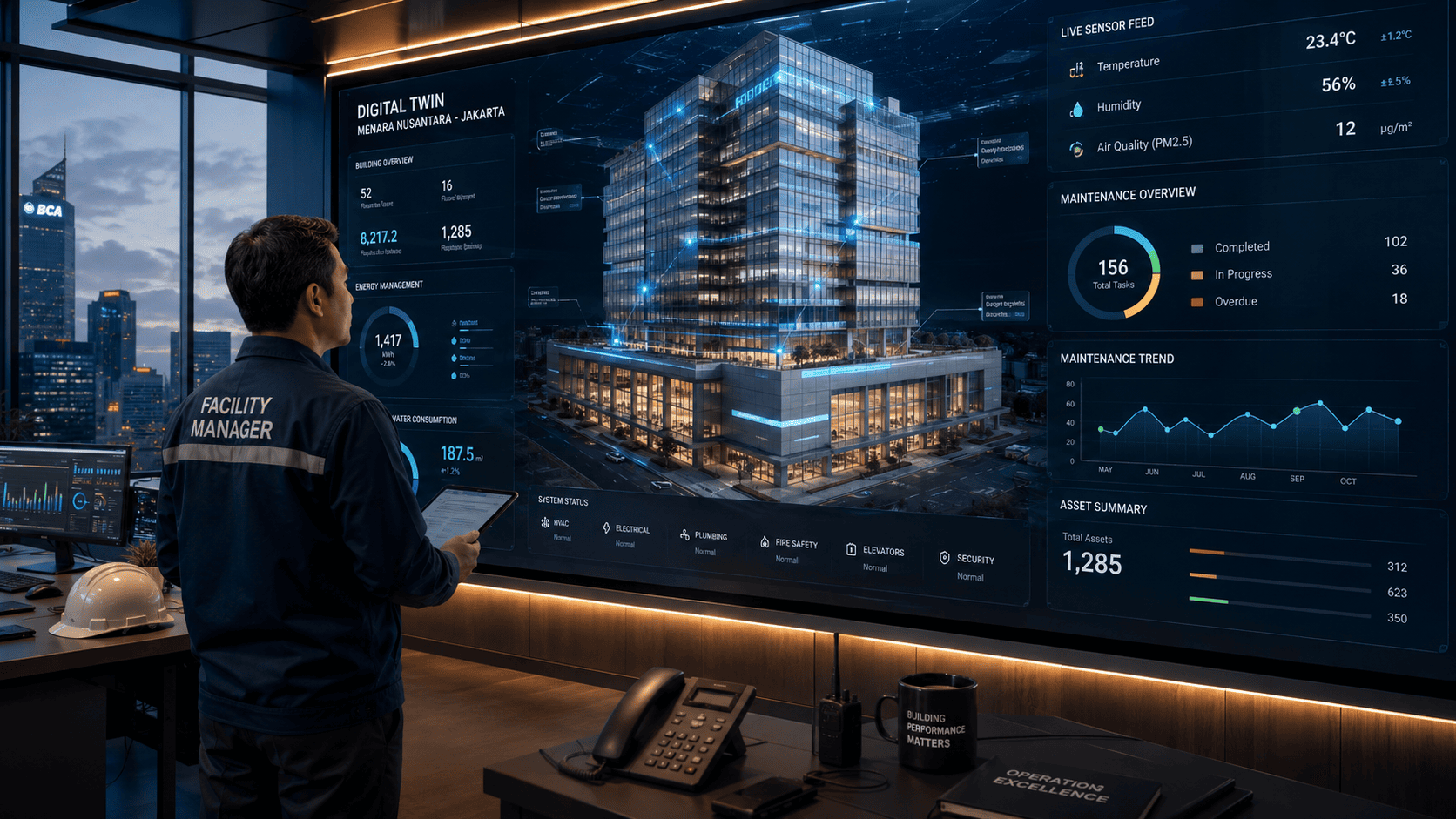
A digital twin is a digital representation of a building kept current by data from the real world, so asset condition can be read without visiting the site. Unlike a standard BIM model, a twin is live: it takes continuous input from sensors and building systems across the whole operational life.
How does a digital twin differ from a BIM model?
The two are treated as the same thing because both are three-dimensional models. The difference appears once the building is finished: the BIM model stops, and the twin only then starts working.
| Aspect | BIM model | Digital twin |
| When it is used | Design and construction | Operations, across the asset life |
| Nature of the data | Planned and as-built condition | Current condition, continuously refreshed |
| Update source | Design and site teams | Sensors, building systems, maintenance records |
| Question answered | How will this be built? | What condition is it in now? |
| Primary user | Designers and contractors | Facility teams and asset management |
The consequence of the second row is the one most often ignored: a twin cannot be built on an inaccurate model. Where the as-built model still reflects the design drawings rather than what was installed, every sensor reading attaches to the wrong component. As-built accuracy decides how useful the twin will be, and it is not work that can be caught up later.
What does a digital twin consultant do?
The work is mostly about data, not technology. The sequence below holds on nearly every engagement, and only the last step involves equipment.
- Assess data readiness: how closely the model matches built condition, and what asset data the maintenance team already holds.
- Structure asset data so every component carries a consistent identity that can be referenced across systems.
- Connect the model to operational data sources, including the building automation system and the maintenance management system.
- Build the view the operations team uses daily — not a three-dimensional model, but answers to the questions they ask every day.
- Train the facility team so the twin is genuinely used after handover rather than stalling as a demonstration.
The fourth step decides whether the project succeeds. Maintenance teams do not open a three-dimensional model to do their work. They ask which air handling unit has drifted this week, when it was last serviced, and which spare it takes. A twin that does not answer questions in that shape stops being opened within months.
Which data must be ready first?
Twin projects stall on data, not technology. The four items below are prerequisites, and none can be skipped.
- An as-built model reflecting what was built, not design drawings never updated after site changes.
- Consistent component naming, so one piece of equipment carries the same identifier in the model, in the automation system, and in the maintenance record.
- An equipment register carrying the attributes the maintenance team actually uses — capacity, install year, service interval — not the full design parameter set.
- Clarity on who owns the data after handover, and who updates it when equipment is replaced.
Where one is missing, the first phase of work is tidying data rather than installing sensors. This is the part that surprises owners most, because it does not look like technology and is hard to demonstrate in a meeting. Skipping it means building a monitoring system on a foundation nothing can reference.
The fourth item is the most frequently forgotten and the most expensive to forget. A twin with no named owner for updates drifts away from reality within a year, and after that nobody trusts its readings.
When does a digital twin earn its cost?
A twin makes most sense when the building will be operated long term by the same owner, and when maintenance cost already has management attention. Outside those two conditions the benefit is hard to feel, because whoever enjoys the result is not whoever pays for it.
- Commercial buildings or estates operated in-house over the long term, not built for sale on completion.
- Facilities with dense mechanical and electrical equipment, where maintenance scheduling drives operating cost.
- Portfolios of buildings intended to be monitored from one place on a consistent basis of comparison.
For assets about to be sold or transferred, complete as-built data alone is the more sensible stopping point. That data retains its value for the next owner, and costs a fraction of building a twin nobody will operate long enough to benefit from.
What does BIMAGE 360 actually do?
BIMAGE 360 is a digital twin platform developed in-house by BIMAGE. It brings together three sources that normally sit apart — the building model, readings from building systems, and asset records — into a single view a facility team can open without modelling software.
| What it unifies | Where it comes from | The question it answers |
| Model and spatial context | As-built model | Which spaces does this equipment serve? |
| Operational readings | Building automation system | How does its condition compare with last week? |
| Asset history | Maintenance records | When was it last serviced, and how often has it failed? |
| Cost and work order data | The operator’s ERP or CMMS | What is this system costing the maintenance budget? |
The last row separates it from a conventional monitoring dashboard. Because it is developed in-house, data coverage can be shaped around the systems a facility team already runs, including integration with existing enterprise resource planning and maintenance management systems. Operators do not have to replace what they have in order to start.
Frequently Asked Questions
Does a digital twin need sensors?
Not at the start. Many implementations begin with existing asset data and maintenance records, adding sensors to the systems that most affect operating cost. Installing sensors before asset identity is consistent produces readings that cannot be attached to any component.
Can an old building have a digital twin?
Yes, provided built condition can be re-documented. The first step is capturing installed condition and producing an as-built model, because the original drawings of an operating building almost always differ from reality after years of refurbishment and equipment replacement.
Who maintains it after handover?
The facility team, and that has to be decided before the project starts rather than after. A twin with no named owner for updates drifts from real conditions quickly. This is why mentoring and training form part of the work rather than an optional extra.
Digital twin vs BIM?
A BIM model answers how the building will be built, and stops working when construction ends. A digital twin answers what condition the building is in now, and starts working when construction ends. An accurate BIM model is its raw material; without one, a twin cannot be built.
Sources
- ISO 19650-3:2020 — Operational phase of the assets — https://www.iso.org/standard/75109.html
- ISO — Building information modelling (BIM), seri ISO 19650 — https://www.iso.org/sectors/building-construction/building-information-modelling
Get an Initial Consultation with BIMAGE Indonesia
BIMAGE Indonesia supports digital twin delivery from data readiness assessment and as-built modelling through operational data integration on the BIMAGE 360 platform, including for buildings already in operation. If you are unsure whether your asset data is clean enough, a readiness assessment is the cheapest starting point — bring your equipment register and latest drawings to an initial consultation.