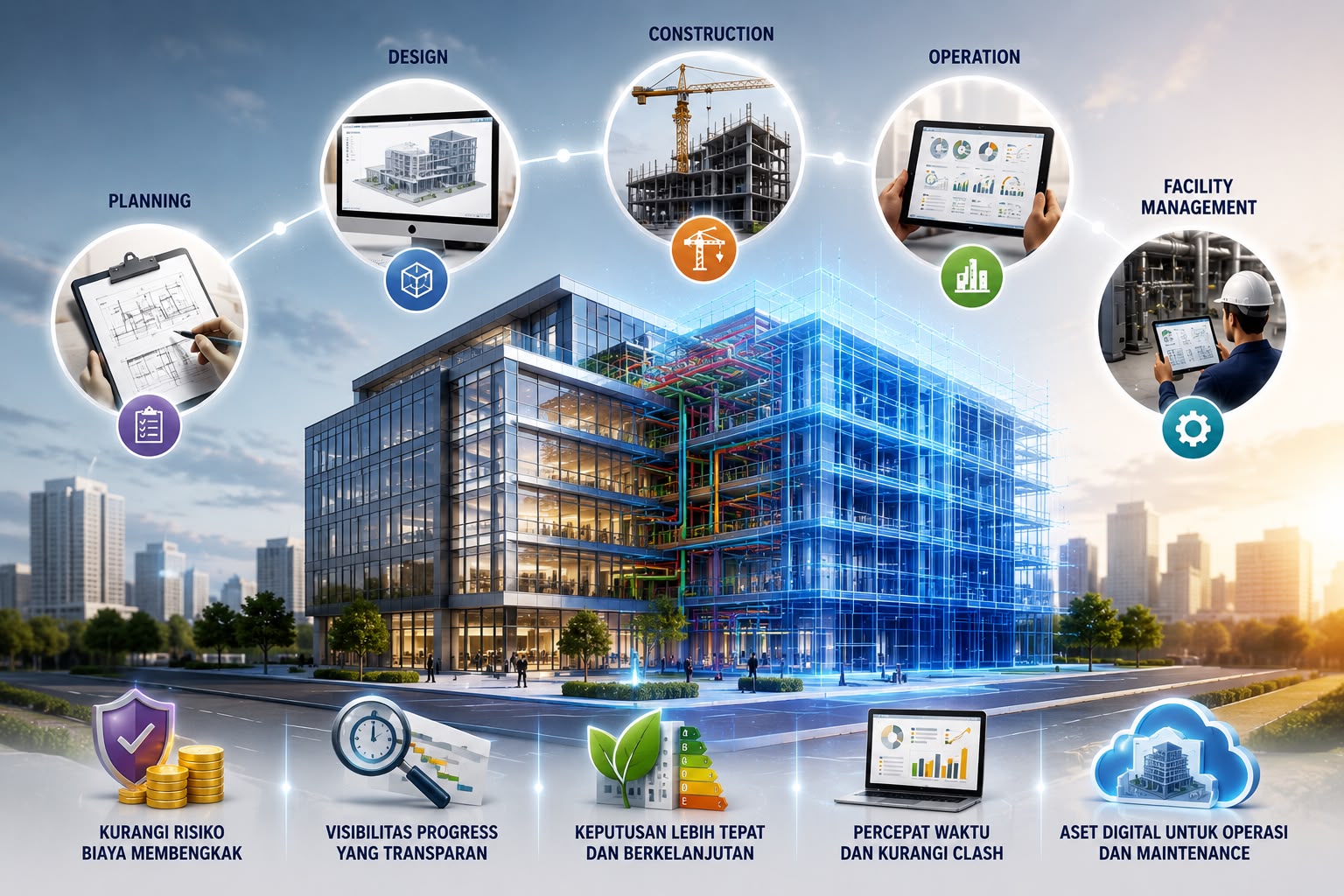
What is BIM? If you work on construction projects—as an engineer, project manager, procurement specialist, or project owner—and want to understand BIM without getting lost in technical terms like LOD, IFC, or CDE, this article is for you. We explain BIM with simple analogies, three concrete things BIM gives your project, when a project should use BIM, and the key questions to ask before choosing a BIM consultant.
What Is BIM — Without the Jargon
BIM, or Building Information Modeling, is a way of designing, building, and operating a building using a digital model that holds all the project's information. Think of BIM as a living database of your building—not a one-off blueprint that is hard to change, but a source of information that keeps updating from the design phase through decades of operation. Every party involved (architects, contractors, MEP engineers, facility managers) works on the same model and can see each other's changes in real time. That is the fundamental difference between BIM and traditional CAD drawings, which are static and split across disciplines.
A Simple Analogy: Paper Map vs Digital Map
An easy analogy: if CAD is a paper map, BIM is a digital map. A paper map gives static information from one point of view; if it changes, you have to reprint it. A digital map gives multidimensional information that automatically updates for all users. BIM works the same way—one master model that holds all the project's information, accessible and updatable by every stakeholder, with a change history for auditability.
3 Things BIM Gives Your Project
First, BIM reduces the risk of cost blowouts. Through 4D and 5D simulation, you can see time and cost scenarios before construction begins, so clashes and inconsistencies are caught in the model—not on site, where fixing them is far more expensive.
Second, BIM gives transparent progress visibility. You can see how far the project has progressed, where the bottlenecks are, and get a more accurate delivery estimate.
Third, BIM produces a digital asset of your building. After construction, you have a complete digital model for facility management that lowers maintenance costs across the building's lifecycle.
When a Project Should Use BIM
Consider BIM when: (1) the project is large and complex; (2) it involves many disciplines (mixed-use, hospitals, industrial facilities); (3) it is a government project—already mandatory under Permen PUPR 22/2018 for buildings above 2,000 m²; (4) it has a tight timeline where fast coordination is critical; or (5) you plan to operate the building long term, where the BIM digital asset is materially valuable for facility management. For very small, single-discipline projects, the BIM overhead may not yet be worth it.
Questions to Ask Before Choosing a BIM Consultant
Before choosing a BIM consultant, ask: (1) Are you an Autodesk Authorized Partner, and at what level? Gold and ACC Elite are the highest. (2) Are you ISO 19650 certified? (3) How many BIM projects have you completed—request a portfolio at a similar scale to yours. (4) Does the team have certified BIM modelers who understand the methodology, not just the software? (5) What is the engagement model—project-based, retainer, or hybrid? (6) How are deliverables handed over—model files, documentation, or with in-house team training? (7) What post-handover support is provided? A credible consultant answers transparently and shows concrete proof for every claim.
Get an Initial Consultation with BIMAGE Indonesia
BIMAGE Indonesia is an Autodesk Gold Partner and ACC Elite, certified to ISO 9001 and ISO 19650, with 400+ global projects. We explain BIM in plain terms—not heavy jargon, but a clear business case for your project. Beyond consulting and implementation, BIMAGE also provides BIM training and implementation mentoring for your team. Contact us for an initial consultation to discuss your project and assess whether BIM fits its scale and complexity.
Related Articles
Explore related topics in the BIMAGE BIM guide:
- Complete guide to Building Information Modeling (BIM)
- 10 real benefits of BIM for construction
- How to choose a BIM consultant in Indonesia
- BIM explained: definition, components, and benefits
Frequently Asked Questions (FAQ)
What is BIM in simple terms?
BIM is a way of designing and building using a digital model that holds all the project's information—a single source of truth that everyone involved can access in real time.
Do I need to understand BIM technically?
No. You only need to understand the business benefits: lower cost risk, progress visibility, and a post-construction digital asset. The technical detail is the responsibility of the engineering team and BIM consultant.
When should a project use BIM?
Consider BIM for large, complex projects with many disciplines, government projects (mandatory under Permen PUPR), projects with tight timelines, or when you plan to operate the building long term.
What is the most important question when choosing a BIM consultant?
Three key questions: (1) Are you an Autodesk Gold Partner or ACC Elite? (2) Are you ISO 19650 certified? (3) How many BIM projects at a similar scale have you completed? Transparent answers signal credibility.
Is BIM only worth it for large projects?
BIM delivers the most material benefit on large, complex projects. For small, single-discipline projects the overhead may not yet be worth it. A credible consultant will tell you honestly if your project does not yet need BIM.